What a perpetual future is
A perpetual future, or perp, is a futures contract with no expiry date. You hold it for as long as your margin allows. Most crypto derivatives volume trades in perps, on centralized exchanges and on Hyperliquid, which is why their funding, open interest and liquidations matter (usemarkov.com/glossary/, read 6 Nov 2026).
A dated future ends on a set day and settles. A perp never does, so something else has to keep its price close to the spot price of the coin. That something is funding.
The four parts
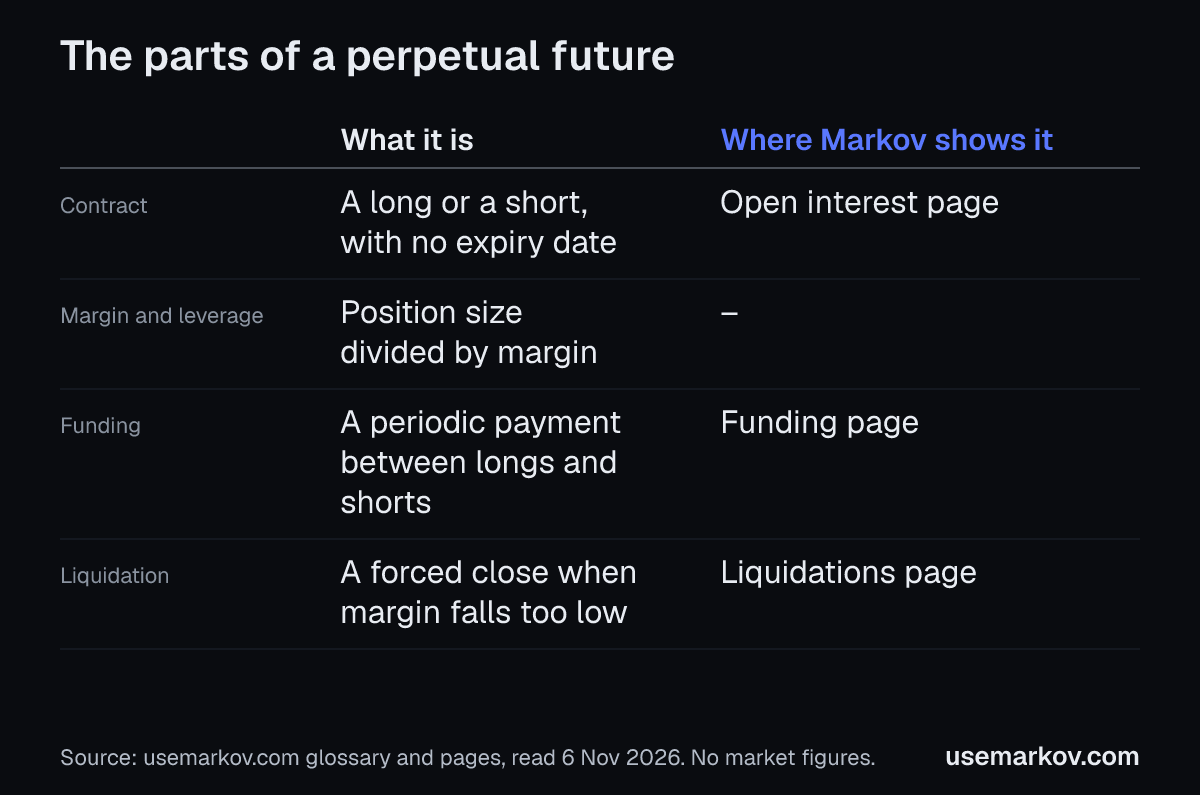
- The contract. You take a long, which gains when price rises, or a short, which gains when it falls. Open interest is the total of contracts still open, and every long has a matching short.
- Margin and leverage. Margin is the money you put up to hold the position. Leverage is the position size divided by that margin: a $10,000 position held with $1,000 of margin is 10 times leveraged, since 10,000 / 1,000 = 10. The amounts are invented for the example.
- Funding. Funding is a periodic payment between longs and shorts that keeps the perp near spot. When the rate is positive, longs pay shorts; when it is negative, shorts pay longs. Hyperliquid pays it every hour. It builds its rate from a fixed interest component of 0.01% per 8 hours, or 0.00125% an hour, plus a premium that moves with the perp's gap to spot; when the premium is small the rate sits near 0.00125%. Hyperliquid's docs print the payment as
position_size * oracle_price * funding_rate, so a bigger position pays or receives more (hyperliquid.gitbook.io/hyperliquid-docs/trading/funding, read 6 Nov 2026). On the same invented $10,000 position, one hour at 0.00125% is 10,000 x 0.0000125 = $0.125, which would be $3.00 over 24 hours if the rate held, paid by longs to shorts while the rate is positive. Neither number is a forecast or a fee schedule: the rate changes every hour. - Liquidation. A liquidation is the forced closing of a leveraged position because its margin fell below the exchange's maintenance requirement. On Hyperliquid, "Liquidations use the mark price, which combines external CEX prices with Hyperliquid's book state" (hyperliquid.gitbook.io/hyperliquid-docs/trading/liquidations, read 6 Nov 2026). Each exchange sets its own requirement, so this post gives no liquidation price.
Where Markov shows each part
- Funding. The BTC funding page reads Hyperliquid's funding live. For what the rate was over a week, see What are Hyperliquid funding rates?, and for what a negative rate means, What does a negative funding rate mean?.
- Open interest. The BTC open interest page reads Hyperliquid open interest live. For a single coin's history, see the DOGE open interest post.
- Liquidations. The BTC liquidations page shows the liquidations that printed on three exchanges. Markov shows only liquidations that printed, not projected levels. For how to read the map, see the ETH liquidation heatmap post.
- Order book. The chart draws Hyperliquid's resting order book under the candles. See the Hyperliquid order book heatmap post.
- Large trades. Whale prints come from Hyperliquid's trade stream, with a size threshold for each coin, and are explained in the glossary.
On the Free plan, and what Pro adds
The Free plan covers BTC, ETH and SOL with an account and no card. It includes the liquidations map, the open interest pane, whale prints, the order book heatmap and funding on the Derivatives tool, which lists funding and open interest across the major perps, most unusual first. Pro adds more coins, the funding pane on the chart and recorded history (usemarkov.com/pricing, read 6 Nov 2026).
How to read this
This is an explanation of how a perp works. It is not advice, and it says nothing about where any price goes next. The dollar examples use invented amounts to show the arithmetic.
See it live
The live chart puts the book, whale prints and liquidations on one time axis for BTC, ETH and SOL with a free account. You can look at it beside whatever you use now. See also the glossary entry for perpetual futures and the plans.
Source: usemarkov.com/glossary/, usemarkov.com/blog/hyperliquid-funding-rates/, usemarkov.com/pricing/, and hyperliquid.gitbook.io/hyperliquid-docs/trading/funding and /liquidations, read on 6 November 2026. The dollar examples are arithmetic on invented amounts.
Markov provides research tools and education, not financial advice. Past data says what happened, not what will.